
A belly is a section of sewer line that has sunk lower than the pipe on either side, creating a low spot where water and waste collect instead of flowing downhill. Small bellies may cause no trouble, but deeper ones trap solids and lead to repeat clogs. The permanent fix is to dig up the sagging section and reset it on a firm base at the correct slope.
Sewer lines rely on gravity. They need a steady downhill slope, commonly about a quarter inch per foot, so waste keeps moving toward the city main. A belly breaks that slope. On a camera, it looks like the lens dipping into standing water in the middle of the line.
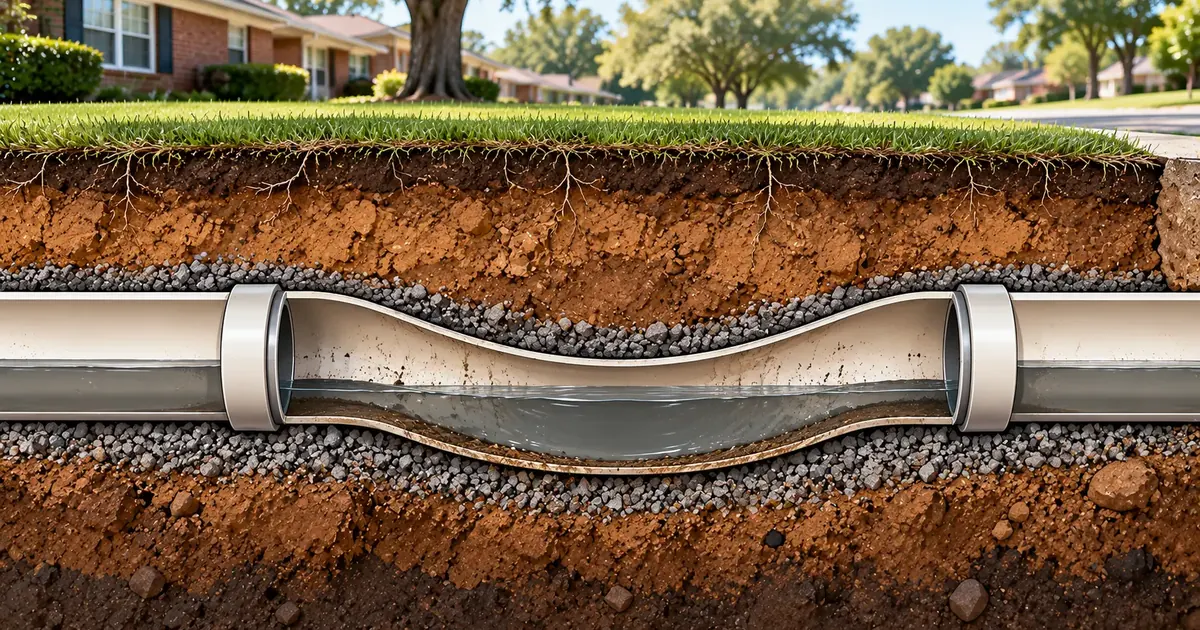
What Causes a Belly?
- Soil settling under loosely backfilled pipe.
- Clay soil movement. Much of the ground around Pine Bluff swells and shrinks with the weather.
- Washouts from a leaking joint carrying away the soil below the pipe.
- Poor original installation with no firm bedding or too little slope.
- Heavy loads pressing down on a shallow line.
How Serious Is Your Belly?
| What the camera shows | How serious | Usual action |
|---|---|---|
| An inch or so of clean water, short stretch | Minor | Monitor |
| Water covering a quarter to half the pipe, some solids | Moderate | Periodic cleaning or plan a repair |
| Water filling half the pipe or more, solids building up, repeat clogs | Serious | Repair the section |
| Belly plus cracks, roots or offsets | Serious | Repair or replace that run |
What Are the Signs?
- Clogs that come back every few months even after cleaning.
- Drains that slow gradually rather than stopping suddenly.
- Sewer smell from waste sitting and breaking down in the low spot.
- Standing water visible on a camera inspection.
How Is a Belly Fixed?
The lasting fix is excavation: dig along the sagging section, remove the soft soil, lay compacted gravel bedding and set new pipe at the right slope, checked with a level and the camera. See bellied sewer line repair.
Lining does not fix a belly, because the liner follows the sag. Pipe bursting also tends to follow the old path. Periodic jetting can manage a moderate belly while you plan the repair.
Why Are Bellies Common in Flat Towns Like Pine Bluff?
Pine Bluff is mostly flat, so many sewer lines were laid with only a modest fall from the house to the street. When a line starts with little slope to spare, even a small amount of settling can create a low spot. Add clay soil that moves with the seasons and decades of time, and bellies become one of the most common findings on older lines here. When we re-grade a section, we set it to match the slope of the good pipe on either side so the transition is smooth.
Is a Belly a Reason to Replace the Whole Line?
Usually not. Most bellies are a single stretch of pipe. Re-grading that stretch fixes the problem without touching the rest. If the camera also shows cracks, roots or offsets along the line, the numbers may favor a replacement instead.
A camera inspection measures how deep and how long your belly is, which is the key to deciding. That camera-first approach guides all of our sewer line repair in Pine Bluff.
Call and my crew will measure the belly on camera and tell you honestly if it needs fixing now. 24/7.
FAQ
Does a belly get worse over time?
Often yes, especially if a nearby leak keeps washing out soil. A camera check every year or two shows whether it is growing.
Does insurance cover a sewer belly?
Standard policies often treat settling as wear and tear. Some service line coverage includes it.
Can a new PVC line have a belly?
Yes, if it was not bedded properly. Good installation is what prevents it.