
Tree root removal clears roots that have grown into a sewer line, usually through cracked or loose joints in clay pipe. We cut the roots with a rotating cutter or root-cutting jet nozzle and flush them out, then run a camera to find every entry point. Roots grow back through open joints, so lasting results come from sealing or replacing those joints.
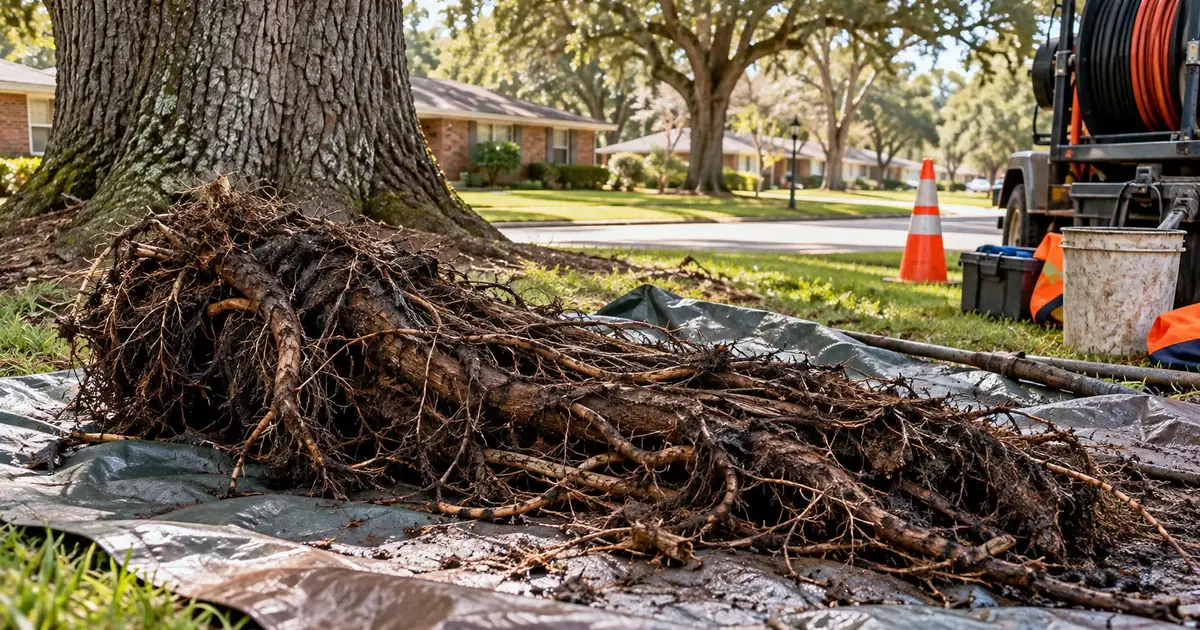
Pine Bluff is full of big, old shade trees, and a sewer line is the best water source in the yard. Roots find the smallest gap at a pipe joint, slip in, and grow into a dense mat that catches toilet paper and grease. It starts as a slow drain and ends with sewage coming up in the tub.
Why Roots Love Pine Bluff Sewer Lines
Most sewer lines under older homes here are clay, laid in short sections joined with mortar or rubber gaskets. Over decades those joints loosen and crack. Roots sense the moisture and nutrients leaking out and grow toward them. Homes in established neighborhoods such as Fifth Avenue, Lake Saracen, Watson Chapel and Henslee Heights, with mature trees close to the line, see this most often. Our guide on signs of tree roots in your sewer line covers the warning signs.
How We Remove Roots
Camera first
We run a camera to see how much root mass there is and whether the pipe is still sound.
Cut the roots
A rotating cutting head or root-cutting jet nozzle slices the roots flush with the pipe wall.
Flush the line
Hydro jetting washes the cut roots and the paper they caught down to the city main.
Camera again and plan
We show you the clean pipe and each joint where roots entered, then give you options and prices to keep them out.
Keeping Roots Out for Good
Cutting roots restores flow, but the open joint is still there. Roots usually return within months to a couple of years. How to stop them depends on what the camera shows:
| What the camera shows | Long-term fix |
|---|---|
| Roots at one or two joints, pipe otherwise sound | Spot repair or a sectional liner at those joints |
| Roots at many joints, pipe round and in one piece | Sewer pipe lining seals every joint without digging up the yard |
| Roots plus cracks, breaks or bellies | Sewer line replacement with glued PVC, which roots cannot get into |
| Light roots, you are not ready to repair yet | Scheduled cutting on a maintenance plan |
Signs Roots Are Already in Your Line
- Drains slow down gradually over weeks, then stop.
- Gurgling from toilets or the tub when other fixtures drain.
- Clogs that come back in spring and summer when trees are growing fastest.
- A soggy or extra-green strip of lawn over the sewer line.
- A plumber pulled roots out on the snake cable last time.
If a snake cable ever came back wrapped in fine, hair-like roots, the roots are still in there. Cutting them without checking the joints on camera only buys time.
Do Root Killers Work?
Copper sulfate and foaming root killers can slow regrowth for a while, but they do not remove a root mass that is already blocking the pipe, and they do not close the joint the roots came through. Rock salt, bleach and vinegar do very little in a sewer line. Read do root killers work in sewer lines before you spend money on them.
What Tree Root Removal Costs
The cost depends on how heavy the roots are, how long the line is and how easy it is to reach. You get the price for root cutting before we start, and separate prices for any long-term fix after you see the camera footage. Some homeowners policies cover damage from roots; our insurance claim help gives you the video and report to ask.
Root problems are one of the most common reasons behind sewer line repair in Pine Bluff, and the camera tells us how far they have gone.
Call and my crew will cut them out, show you where they got in and price the fix that keeps them out. Licensed and insured, 24/7.
Tree Root Removal FAQ
How fast do roots grow back after cutting?
It varies with the tree and the season, but regrowth within several months to two years is common as long as the joint stays open.
Can roots break a sewer pipe?
Yes. As roots thicken inside a joint they can crack clay pipe and push sections out of line, which leads to offsets and collapses.
Which trees cause the most sewer problems?
Large, fast-growing trees with aggressive roots, such as oaks, willows, maples and sweetgums, especially when planted close to the line.
Does insurance pay for root damage?
It depends on your policy. Read does insurance cover tree roots in a sewer line.