
The most common signs of tree roots in a sewer line are drains throughout the house slowing down gradually, gurgling toilets, clogs that come back weeks after being cleared (often worse in spring and summer), and a wet or unusually green patch of lawn over the line. The only way to confirm roots is a sewer camera inspection.
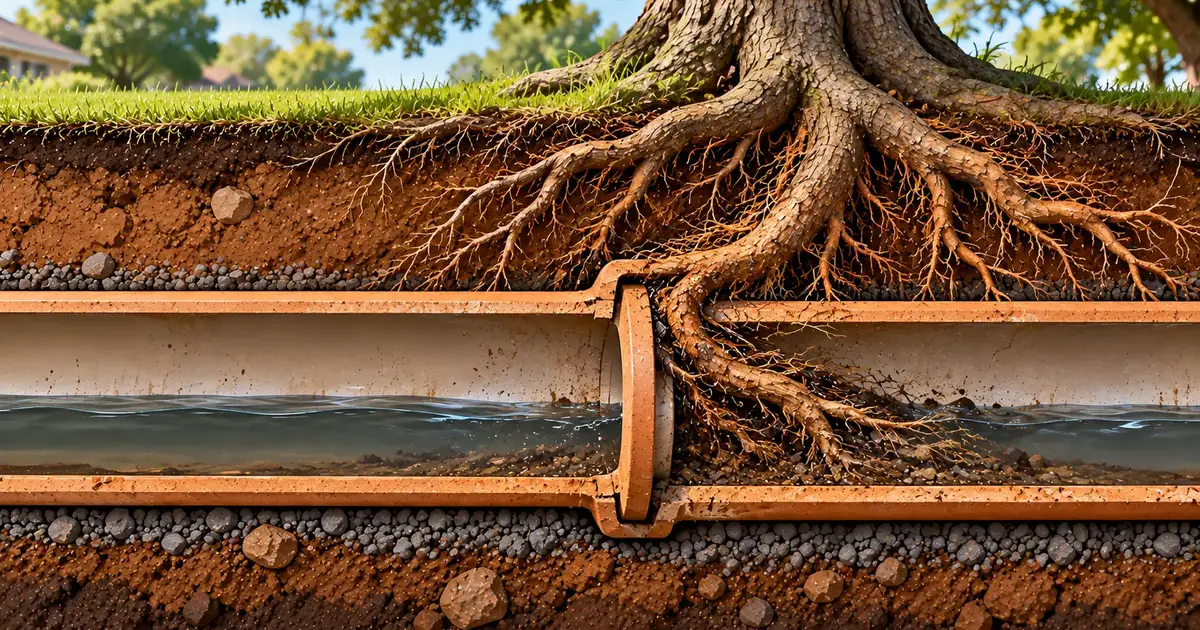
Roots do not block a sewer line overnight. They start as thin, hair-like strands slipping through a gap at a pipe joint, then thicken into a mat that catches toilet paper and grease. Spotting the early signs lets you deal with it before sewage comes up in the tub.
What Are the Early Warning Signs?
- Slow drains everywhere. When several fixtures slow down at once, the main line is narrowing.
- Gurgling toilets when the washer or tub drains, a sign air is being pushed past a partial blockage.
- Clogs that return. A snake punches through the roots, but they grow back fast.
- Seasonal pattern. Clogs worse in spring and summer, when trees grow fastest.
- Roots on the snake cable. If a plumber pulled fine roots out last time, they are still in there.
- Wet or extra-green grass over the line, where leaking sewage feeds the lawn.
- Sewer smell outside near the cleanout or along the line.
How Do You Confirm It’s Roots?
A sewer camera inspection is the only sure way. The camera shows root masses, where they enter, how many joints are affected and whether the pipe is cracked. A locator marks each spot on the ground, which matters later if a repair is needed. You keep the recording, which is useful for insurance, for comparing quotes and for tracking whether roots come back after a repair.
Which Homes Are Most at Risk?
- Homes with clay sewer pipe, laid in short sections with many joints.
- Older homes with cast iron or Orangeburg pipe that has cracked.
- Houses with large trees within 20 to 30 feet of the line.
- Lines that have been snaked for roots before.
That describes a lot of Pine Bluff, especially the older, tree-lined neighborhoods near Lake Saracen, Fifth Avenue and Watson Chapel.
Why Doesn’t Snaking Fix It for Good?
A snake or cutter head slices through the root mass and gets water moving again, but the joint the roots came through is still open. Worse, cut roots tend to grow back thicker, the way a hedge does after trimming. Unless the entry point is sealed or the pipe is replaced, you are on a cycle of repeat cleanings. The camera shows how many entry points there are, which tells you whether a small repair ends the cycle or the line needs bigger work.
What Are the Fixes?
- Cut and flush the roots with root removal and hydro jetting.
- Seal one or two entry joints with a spot repair or point liner.
- Line the whole run with pipe lining if roots are at many joints.
- Replace a line that is cracked and root-filled throughout.
Worried about the cost? Read does insurance cover tree roots in a sewer line, or see how we handle sewer line repair in Pine Bluff.
Call and my crew will camera it, show you every root and price the fix before we dig. 24/7.
FAQ
How fast do roots block a sewer line?
It can take months to years, depending on the tree, the season and the size of the gap.
Can roots break a pipe?
Yes. As roots thicken inside a joint they can crack clay pipe and push sections out of line.
Which trees are worst?
Large, thirsty trees such as oaks, willows, maples and sweetgums, especially planted close to the line.