
Orangeburg pipe is a sewer pipe made of layers of wood fiber pressed together and soaked in coal tar pitch. It was used most heavily from the late 1940s into the early 1970s, when it was cheap and easy to install, and it tends to soften, blister and flatten over time. If your home was built in that era, a sewer camera inspection is the only reliable way to know if you have it.
Orangeburg takes its name from Orangeburg, New York, where it was manufactured. It had been around since the late 1800s, but it became popular after World War II when metal was scarce and new houses were going up fast. It was light, cheap and quick to lay, which made it attractive to builders. Unfortunately, it was never meant to last as long as most homes do.
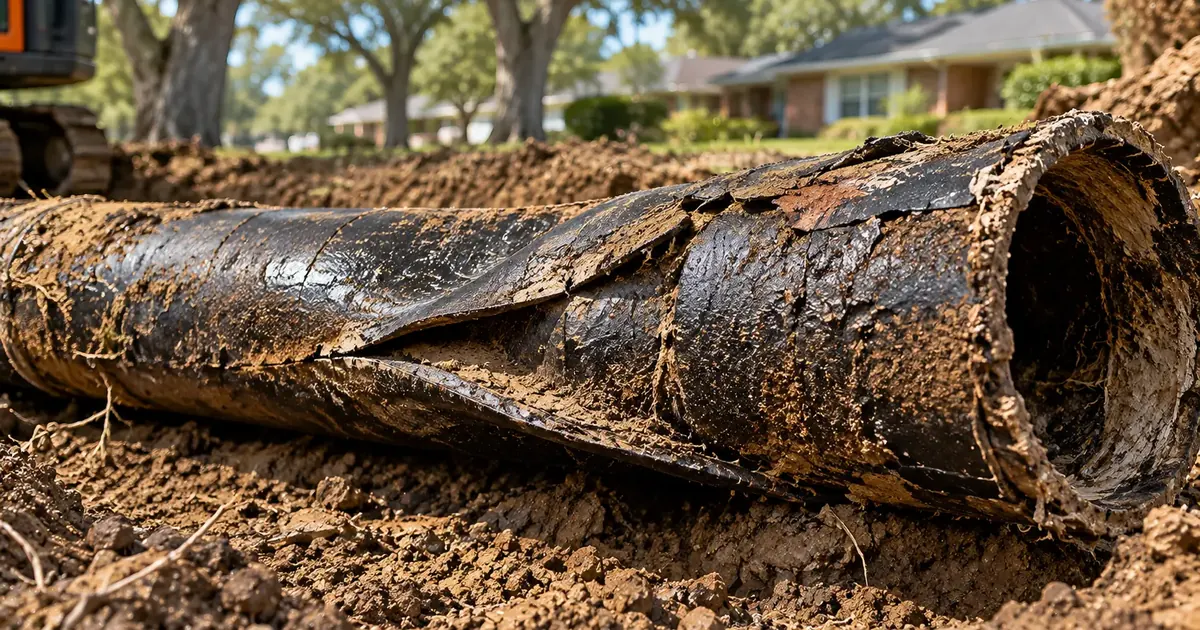
Why Does Orangeburg Pipe Fail?
- It softens. Constant moisture and waste slowly break down the fiber layers.
- It deforms. The weight of the soil above pushes the softened pipe into an oval, shrinking the opening.
- It blisters. Bubbles form on the inside wall and catch waste.
- Roots get through. Roots can push through the pipe wall itself, not just the joints.
- It collapses. Eventually a section caves in completely.
How Can You Tell If Your Home Has It?
Start with the age of the house. Homes built from roughly the late 1940s to the early 1970s are the most likely candidates, and plenty of Pine Bluff neighborhoods were built out in exactly those years. Then look for clues:
- Slow drains throughout the house that get worse over months, not days.
- Clogs a snake cannot fully clear, because the pipe itself is getting smaller.
- A plumber mentioning “black pipe” or “fiber pipe” after a previous repair.
- Soft or sinking spots in the yard along the sewer path.
The definitive answer comes from a camera inspection. On screen, Orangeburg looks black and fibrous, often with blisters, and a failing section looks oval or pinched instead of round.
What Should You Do If You Have It?
| Camera finding | Usual recommendation |
|---|---|
| Still round, no major blisters | Monitor with periodic camera checks, plan ahead |
| Oval, blistered or root-filled | Plan replacement soon |
| Collapsed section, backups | Replace now |
Because the material itself is the problem, patching one spot rarely helps for long, and lining usually is not possible once the pipe has deformed. The standard fix is Orangeburg pipe replacement with PVC by trench, or pipe bursting when the line runs under a driveway or trees.
Can You Repair Just Part of an Orangeburg Line?
Sometimes a past owner already replaced part of the line with PVC, and only a stretch of Orangeburg remains. In that case, replacing just the remaining Orangeburg section makes sense. What rarely works is patching a single flattened spot in the middle of a long Orangeburg run, because the pipe on either side is the same age and material and usually close behind.
Should You Avoid a House With Orangeburg?
Not necessarily. It is a known, fixable problem. If you are buying, a pre-purchase sewer inspection tells you whether it is there and how far gone it is, so you can negotiate a repair or a credit before closing.
Curious about the material itself? Read does Orangeburg pipe contain asbestos, or see how we approach sewer line repair in Pine Bluff.
Call for a camera check. We will tell you if you have Orangeburg and what it will take to replace it. 24/7.
FAQ
How long does Orangeburg pipe last?
It was commonly expected to last around 50 years, and many lines began failing sooner, especially in wet or heavy soil.
When did they stop using Orangeburg pipe?
Use dropped off in the early 1970s as PVC and other plastics took over.
What color is Orangeburg pipe?
It is black, from the coal tar pitch it was soaked in.