
An offset joint is where two sections of sewer pipe have shifted so they no longer line up, leaving a ledge inside the pipe. A separated joint has pulled apart, leaving a gap. Both catch toilet paper and waste, let roots in, and leak sewage into the soil. The repair is to dig at the joint, remove the misaligned section and reconnect new pipe with shielded couplings so it stays in line.
On a camera screen, an offset joint looks like a step. The pipe runs smooth, then suddenly the next section sits an inch higher or lower. Waste flowing down the line hits that lip, paper snags on it, and before long you have a clog that keeps coming back in the same spot. Snaking clears it for a while, but the step is still there.
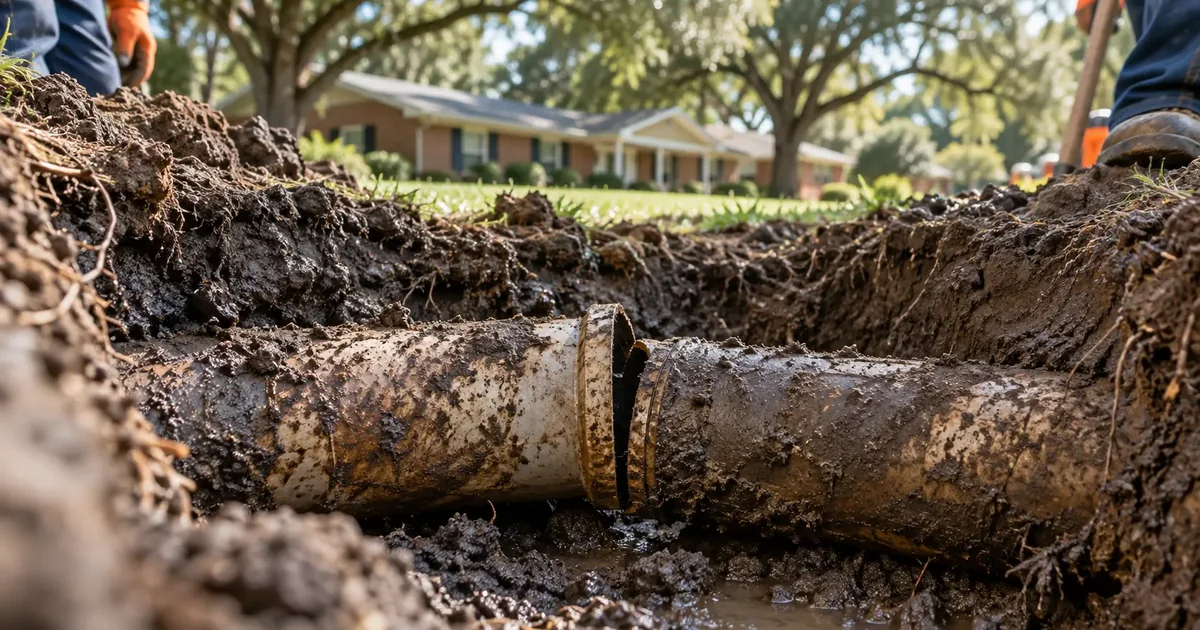
What Causes Offset and Separated Joints
- Soil movement. Clay soil common around Pine Bluff swells in wet weather and shrinks in drought, pushing pipe sections up, down or apart over the years.
- Short pipe sections. Old clay sewer pipe came in 2 to 3 foot lengths, so a long line has dozens of joints that can shift.
- Roots. A root growing into a joint slowly pries the two pipe ends apart.
- Weight and vibration. Heavy vehicles, driveways and nearby construction can nudge a shallow line out of alignment.
- Poor past repairs. Rubber couplings without a steel shield can sag, letting the new and old pipe drift apart.
Where We Find Offsets in Pine Bluff Lines
The most common spots are predictable. Right where the pipe leaves the foundation, because the house and the yard settle at different rates. Under driveway edges, where the load changes suddenly. Near large trees, where roots push on the joints from outside. And at old repair points, where someone joined new pipe to clay with a plain rubber boot and no steel shield. When we run the camera on a home built between the 1940s and 1970s, it is common to see more than one offset along the same line.
Why You Should Not Ignore an Offset
An offset starts as a nuisance and becomes a bigger problem. The ledge causes repeat clogs. The gap lets sewage leak into the ground and soil wash into the pipe. Roots move in through the opening. Over time the leak can wash out the support under the pipe, the section sags into a belly, and eventually it can crack or collapse. Fixing one joint now is far cheaper than fixing what it turns into.
How We Fix an Offset Joint
Camera and mark
A camera inspection finds every offset or gap, and the locator marks each one’s position and depth.
Decide the method
A single bad joint usually gets a spot excavation. Several joints close together may be better served by lining or replacing that run.
Dig and realign
We expose the joint, cut out the shifted piece, bed the pipe on firm gravel at the correct slope and connect new PVC with shielded couplings.
Camera again
A final camera pass shows a smooth, aligned joint before we backfill.
Can Offsets Be Fixed Without Digging?
Sometimes. A mild offset, where the pipe is still round and the step is small, can be bridged with a sectional liner or a full sewer pipe lining. A liner seals the joint and keeps roots out, but it follows the pipe’s shape, so it cannot remove a large step or fix a gap wide enough for soil to fall in. For those, digging and realigning is the lasting fix. Trenchless sewer repair explains when no-dig methods work.
| Camera finding | Usual repair |
|---|---|
| One joint, small step, pipe round | Sectional liner or spot repair |
| One joint, large step or open gap | Spot repair, dig and realign |
| Several offsets along the line | Line the run, or replace it |
Cost and Timing
A single-joint repair is usually finished in a day. Price depends on depth and what covers the pipe. You get the camera footage, the marked locations and the price before any digging. Financing is available for larger jobs.
Offsets are a common find during sewer line repair in Pine Bluff, especially in older clay lines, and they are one of the easiest problems to fix once you know where they are.
That is often an offset joint. Call and my crew will show you on camera and price the fix before we dig. 24/7.
Offset Joint FAQ
How do I know if I have an offset joint?
Only a camera can confirm it. Repeat clogs in the same spot and roots that keep returning are common clues.
Is a small offset a problem?
A very minor offset may drain fine for years. If it catches waste or lets roots in, it is worth fixing before it gets worse.
Will the joint shift again after repair?
We bed the new pipe on firm gravel and use shielded couplings with a steel band, which keeps the connection aligned far better than plain rubber couplings.
Can hydro jetting fix an offset?
Jetting clears what is caught on the offset, but it cannot move the pipe back into line. The joint itself needs repair.