
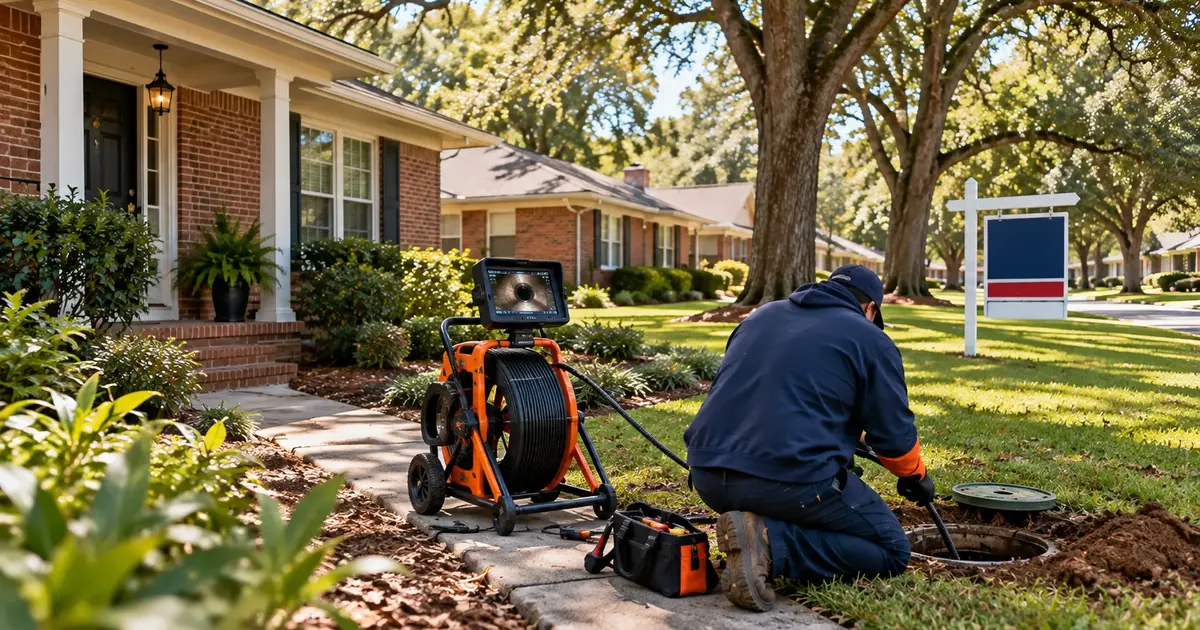
A pre-purchase sewer inspection is a camera inspection of the sewer line from the house to the city main, done before you close on a home. A standard home inspection usually does not look inside that pipe, so roots, breaks, bellies or failing Orangeburg pipe can go unnoticed until after you own the problem.
A home inspector checks the roof, the wiring and the water heater. Most do not run a camera through the sewer line, and it is one of the most expensive things to fix in a house. In a town like Pine Bluff, where much of the housing was built between the 1940s and the 1990s and some homes near Fifth Avenue go back more than a century, the pipe under the yard is often as old as the house.
Why Buyers Should Scope the Sewer
- It is not in the standard inspection. The sewer lateral is usually outside the scope of a general home inspection.
- Problems hide well. A vacant house with light water use can drain fine during a showing and back up the first week you move in.
- Repairs are costly. A full line replacement can run into the thousands. Knowing before you close gives you room to negotiate.
- Old pipe types matter. Clay, cast iron and Orangeburg pipe all have limited lifespans, and the camera tells you which one you are buying.
What We Check
Pipe material
Clay, cast iron, PVC or Orangeburg, and where one type connects to another.
Condition
Cracks, breaks, offset joints, bellies, corrosion and flattening along the full run.
Roots and buildup
Root intrusion at joints and grease or scale narrowing the pipe.
Location and depth
Where problem spots sit in the yard and how deep, marked with our locator.
What You Get
- The full video recording of the inspection.
- A plain-English summary of what we found, with timestamps for each problem spot.
- Our recommendation: no action, cleaning, a spot repair or a full replacement.
- A written price for any repair, which you can use in negotiations with the seller.
What We Commonly Find by House Age
| When the house was built | Likely pipe | What to watch for |
|---|---|---|
| Before 1940 (for example near Fifth Avenue and downtown) | Clay, sometimes with cast iron inside the house | Root intrusion at joints, cracked sections, repairs done in mixed materials over the years |
| 1945 to 1970s | Cast iron, clay or Orangeburg fiber pipe | Orangeburg flattening, cast iron rusting through at the bottom, roots in clay joints |
| 1980s and later | Mostly PVC or ABS plastic | Bellies from settling soil, offset joints, damage from later construction or utility work |
These are patterns, not rules. Plenty of older lines have been partly replaced, and some newer ones were installed poorly. That is exactly why the camera matters more than the age of the house.
Red Flags on the Video
- Standing water in the pipe that does not drain away, a sign of a belly or blockage.
- Roots hanging from several joints rather than one.
- A pipe that looks oval instead of round, typical of failing Orangeburg.
- Visible soil or daylight through a break in the pipe wall.
- A camera that cannot pass a certain point at all.
For Sellers and Real Estate Agents
Sellers can scope the line before listing to avoid surprises in the middle of a deal. A clean video is a strong selling point, and a known problem can be fixed or priced into the sale up front. Agents are welcome to call us to schedule on behalf of a client, and we work around showing schedules and access instructions.
What If the House Has No Cleanout?
Many older Pine Bluff homes were built without an outdoor cleanout. We can often inspect through a roof vent or by pulling a toilet with the seller’s permission. If the line needs a cleanout for future service, we can quote a sewer cleanout installation as part of the report.
A pre-purchase inspection follows the same camera-first approach we use for all sewer line repair in Pine Bluff. You see the footage and you decide, with real information in hand.
Call and we will schedule a sewer camera inspection that fits your inspection deadline. Video and written summary included.
Pre-Purchase Sewer Inspection FAQ
Does a regular home inspection include the sewer line?
Usually not. Most general inspections check fixtures and visible plumbing but do not run a camera through the underground sewer line. Ask your inspector what is included.
Who pays for the sewer inspection?
The buyer usually pays, just like other inspections. Some sellers order one before listing to make the house easier to sell.
What if the camera finds a problem?
You get the video and a written repair price. Buyers commonly ask the seller to repair it, lower the price or give a credit at closing.
Is the inspection worth it for a newer house?
Newer PVC lines fail less often, but construction damage, roots and bellies still happen. Read Is a Sewer Camera Inspection Worth It? to decide.