
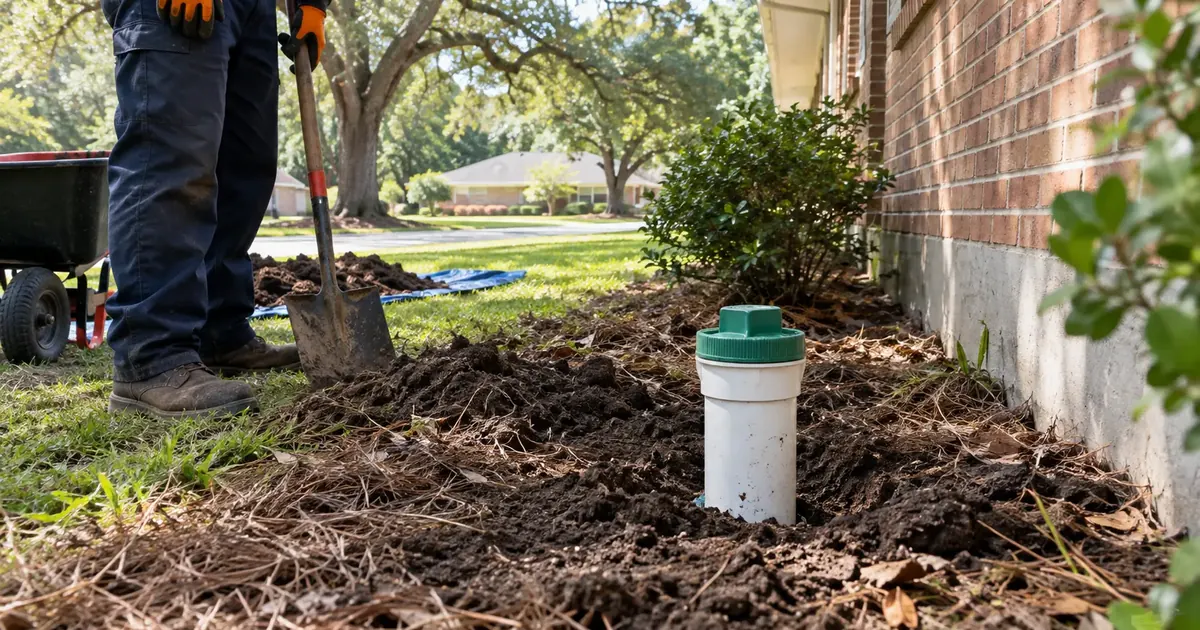
A sewer cleanout is a capped pipe that rises from your sewer line to ground level, usually near the foundation or between the house and the street. It gives direct access to the main line for clearing clogs, running a camera and jetting. Installing one means digging to the sewer line, cutting in a fitting that points toward the city main, and bringing a capped riser up to grade.
If a plumber has ever had to pull your toilet or climb on your roof to clear the main line, your house probably does not have a usable outdoor cleanout. That is common in older Pine Bluff homes, many built before cleanouts at the foundation became standard practice. Without one, every clog takes longer, costs more and carries more risk of mess inside the house.
Why a Cleanout Is Worth Having
- Faster, cheaper clog clearing. No toilet pulling or roof access, so visits take less time.
- Less mess. If the line is full, the backup can be released outside instead of in your bathroom.
- Better camera inspections. The camera goes straight into the main line toward the street.
- Required for some repairs. Hydro jetting and pipe lining both work best through a proper cleanout.
- Emergency relief. When the main line clogs, opening the cleanout can stop sewage rising in the house while you wait for help.
One-Way vs. Two-Way Cleanouts
| One-way cleanout | Two-way cleanout | |
|---|---|---|
| Access | Toward the city main only | Toward the main and back toward the house |
| Best for | Simple lines with few problems | Most homes, and lines that need regular service |
We usually recommend a two-way cleanout. It lets us clear or camera the line in both directions from one spot.
How We Install a Cleanout
Locate the line
A camera and locator find where the sewer leaves the house and how deep it runs.
Mark and dig
After 811 marks buried utilities, we dig a small hole down to the pipe near the foundation.
Cut in the fitting
A section of pipe is removed and a cleanout fitting goes in, joined with shielded couplings, with the riser brought up to ground level.
Cap and finish
A threaded cap goes on top, the hole is backfilled, and we show you where it is and how to open it in an emergency.
A Good Time to Add One
If we are already digging near the house for a spot repair or line replacement, adding a cleanout in the same hole costs much less than a separate trip. On replacements we include one as standard.
Where Cleanouts Hide in Older Homes
Some Pine Bluff homes have a cleanout that is simply buried. Over years, mulch, soil and grass creep over the cap until nobody remembers it is there. Before installing a new one, we check the usual spots: close to the foundation on the side facing the street, near where the bathrooms sit, beside the driveway, and in a crawlspace just inside the foundation wall. Finding a buried cleanout is always cheaper than installing one. Our guide how to find your sewer cleanout shows what to look for. If the old cleanout is cracked, too small or points the wrong way, we replace it with a proper full-size fitting.
What a Cleanout Saves You Over Time
Think about the last clog. Without a cleanout, the plumber had to pull a toilet, set it aside, run the cable through the toilet flange, then reset the toilet with a new wax ring. Or they went on the roof and fed the cable down a vent, which is slower and harder to steer into the main line. Each of those visits takes longer and costs more than opening a cap in the yard. For homes with roots or a known belly that need clearing every year or two, a cleanout often pays for itself after a few visits. It also means that in an emergency at night, a crew can get flow moving within minutes of arriving.
A cleanout makes every future sewer line repair in Pine Bluff faster and cheaper for your home.
Call and we will locate your line and quote a cleanout, or add one during your next repair. Price before we dig.
Sewer Cleanout FAQ
How do I know if I have a cleanout?
Look for a round capped pipe, usually white PVC or black, 3 to 4 inches wide, near the foundation or in the front yard. It may be buried under mulch or grass.
How long does cleanout installation take?
Most installs are done in a few hours, depending on depth and what the line is made of.
Should the cleanout have water in it?
No. Standing water in the cleanout usually means the line is blocked between the cleanout and the city main. Call before it backs up into the house.