
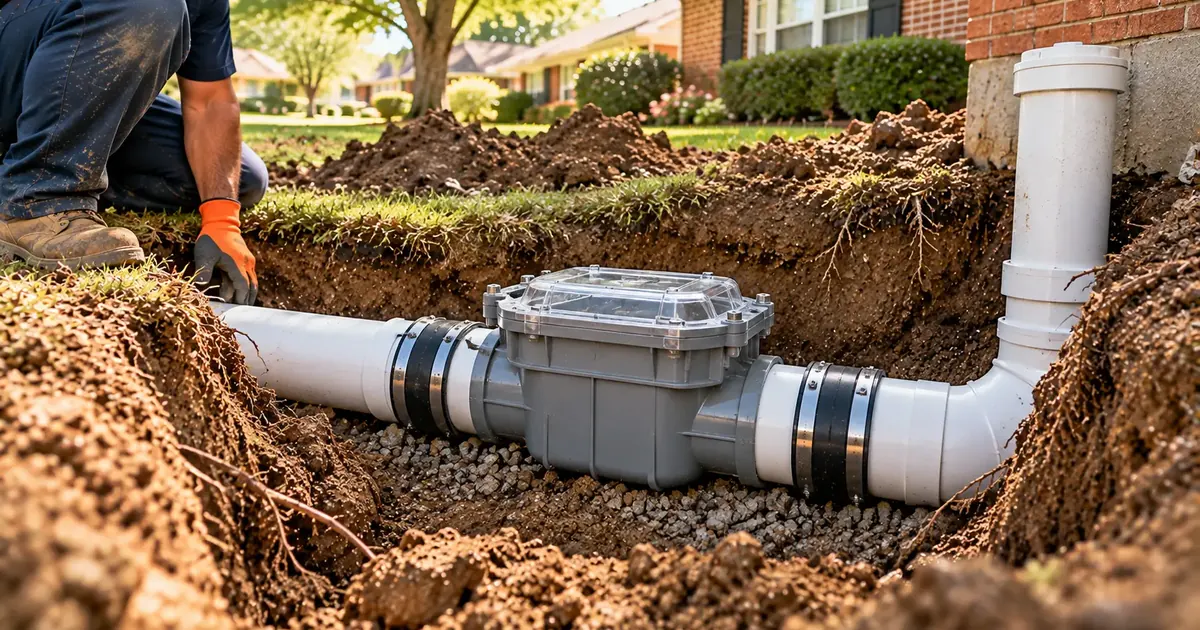
A backwater valve is a one-way valve installed on your main sewer line. Waste flows out of the house normally, but if the city sewer backs up, a flap inside the valve closes and stops sewage from flowing back into your drains. It is installed by cutting into the sewer line, usually outside near the foundation, with an access box so the valve can be inspected and cleaned.
Not every sewer backup starts in your own pipe. When heavy rain overloads the city system, or the public main gets blocked downstream, sewage can push backward up your lateral and out through the lowest drain in the house. Your own line can be in perfect condition and you still end up with a flooded shower or floor drain. A backwater valve is the device made to stop exactly that.
Who Should Consider One
- Homes that have had a backup during a storm while the camera shows the house line is clear.
- Houses with low floor drains, basements or fixtures close to the level of the street or manhole covers.
- Homes in low-lying parts of town where water collects during heavy rain.
- Owners who have had a backup blamed on the city main.
- Anyone whose insurer recommends or offers a discount for backflow protection.
If you are not sure whether your backup came from your line or the city, start with a camera inspection. A clear line during a backup points to the city side, and that is when a backwater valve does its best work. Read can heavy rain cause a sewer backup.
How a Backwater Valve Works
Inside the valve body is a hinged flap or gate. Normal flow from your house pushes it open and waste passes through. When water starts flowing the other way, the flap swings shut and seals against its seat. Most residential valves also have a clear or removable top so the flap can be checked and cleaned. Some models include an alarm that warns when the valve has closed, so you know to hold off on running water until the city side clears.
How We Install It
Confirm the line
We camera the lateral, confirm pipe size and material, and pick the best location, usually outside near the foundation.
Permit and 811
We pull the permit and have buried utilities marked before digging.
Cut in the valve
A section of pipe is removed and the valve is installed level and in the right flow direction, joined with shielded couplings.
Access box and test
An access box brings the valve’s top to ground level for maintenance, and we test the flap before backfilling.
Keeping It Working
A backwater valve needs occasional attention. Debris, grease or roots can keep the flap from sealing. We recommend opening the access cover once or twice a year to check that the flap moves freely and the seat is clean. It is also worth a check after any backup event. If you have a maintenance plan, the valve check is part of each visit.
Is Your Home at Risk of City-Side Backups?
A simple check helps. Compare the height of your lowest drain, often a shower or floor drain, with the manhole cover in the street in front of your house. If that drain sits close to or below the manhole rim, sewage in a surcharged city main has an easy path into your home. Pine Bluff is flat, and many older homes sit only a little above street level, so this is worth a look. We can check it for you during a camera inspection.
Backwater Valve vs. Fixing Your Own Line
A backwater valve protects against city-side backups only. If your own line is clogged with roots, grease or a collapse, the valve cannot help, because the blockage is between your drains and the valve. That is why we always look at your line first. The two work together: a sound house line plus a backwater valve gives the best protection.
Backwater protection fits into our camera-first approach to all sewer line repair in Pine Bluff. For more everyday tips, see how to prevent a sewer backup.
Call and my crew will camera your line and tell you if a backwater valve is the fix. Price before we dig, 24/7.
Backwater Valve FAQ
Is a backwater valve the same as a check valve?
They work on the same one-way principle, but backwater valves are made for gravity sewer lines, with a large opening, a cleanable flap and access for maintenance.
Does a backwater valve slow my drains?
A correctly sized and installed valve does not noticeably slow normal flow.
Can it be installed inside the house?
Sometimes, on a line in a crawlspace or basement. Outdoor installation near the foundation is common because it protects every drain in the house.