
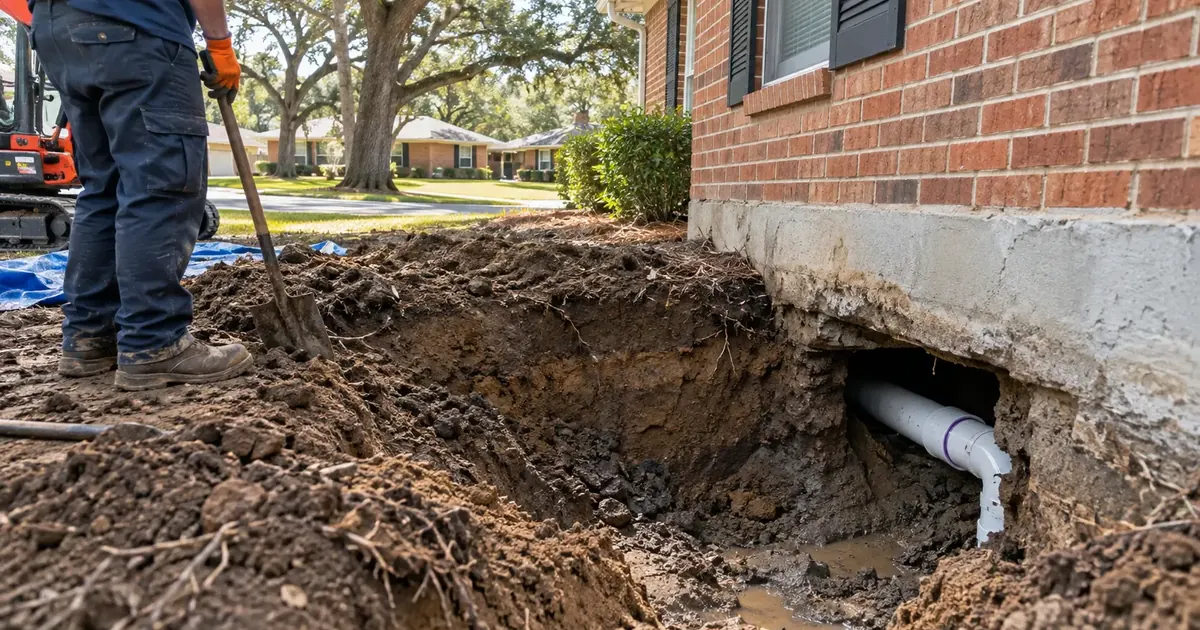
Under-slab sewer repair fixes a drain or sewer line that runs beneath a concrete slab foundation. After a pressure test and camera inspection confirm where the pipe has failed, it is reached by tunneling under the slab from outside, cutting a small section of floor, or rerouting the line. The right method depends on where the break is and how much of the line is damaged.
Many Pine Bluff homes, especially the ranch houses built from the 1950s on, sit on a concrete slab with the drain lines buried underneath. When one of those pipes cracks or rusts through, the leak is out of sight. Sewage soaks the soil under the house, and the first signs are often cracks in the floor, a sewer smell with no source, or a foundation company telling you the slab is moving.
Signs of a Sewer Leak Under the Slab
- New cracks in tile, concrete floors or interior walls.
- A part of the floor that feels raised, soft or damp.
- A sewer or musty smell inside, worse after showers or laundry.
- Doors that suddenly stick or will not latch.
- Slow drains in one wing of the house while the rest drain normally.
Much of the ground around Pine Bluff is clay that swells when it gets wet. Sewage leaking under a slab can make that clay swell unevenly, which lifts or cracks the floor. That is why we take these signs seriously.
Most slab homes of that era were plumbed with cast iron under the floor. Cast iron holds up well for decades, then rusts through along the bottom where water always runs, a problem often called channel rot. By the time you notice it, the pipe may be leaking at several points.
Step One: Confirm the Leak
Nobody should cut a floor on a hunch. We start with a sewer line pressure test to confirm the drain system is leaking, then a camera inspection to find where the pipe is broken, rusted or separated. The locator marks the spot on the floor or the outside wall so the repair can be planned precisely.
Repair Options
| Method | How it works | Best when |
|---|---|---|
| Tunneling | A crew digs an access pit outside and tunnels under the foundation to the damaged pipe | You want to keep floors intact, or the damage is near an outside wall |
| Floor cut | A small section of slab is cut out directly over the break, repaired and re-poured | The break is in one known spot and the floor covering is easy to replace |
| Reroute | New drain pipe runs a different path, through walls or the attic, and the old line is capped | The under-slab line is failing along its length |
| Lining | A liner is installed inside the existing pipe through a cleanout | The pipe is cracked but still round and in one piece |
We explain the trade-offs on your specific footage. Floors, cabinets and furniture placement all affect which method costs less overall.
How We Protect Your Foundation
- New pipe is PVC with shielded couplings where it joins cast iron, so the connection cannot slip or offset later.
- Pipe under a slab is supported and set at the correct slope before backfill.
- Tunnels are backfilled and compacted, and we can coordinate with a foundation company or engineer when a report is needed.
- A final pressure test proves the repaired system holds water before the floor or tunnel is closed.
What Under-Slab Repair Costs
Under-slab work is one of the bigger sewer jobs. Price depends on how far the break is from an outside wall, the depth, the method and the floor covering. You get the test results, the footage and the price before any cutting or tunneling. Financing is available, and our insurance claim help gives your insurer the documentation it needs.
Slab leaks are where proof matters most, and it is why every sewer line repair in Pine Bluff we do starts with testing and the camera.
Call and we will test the drain lines, show you the result and walk you through repair options before anything gets cut.
Under-Slab Sewer Repair FAQ
Will you have to tear up my floors?
Not always. Tunneling from outside or rerouting the line can avoid cutting the floor. The footage and location of the break decide which method makes sense.
How long does under-slab repair take?
A single floor-cut repair may take one to two days plus concrete curing. Tunneling and reroutes take longer depending on distance.
Can a slab leak damage my foundation?
Yes. Leaking water can swell or wash out the soil under the slab, which can crack floors and move the foundation over time.
Can I stay in the house during the repair?
Usually yes, with limited water use while the line is open. We plan the work to keep that time as short as possible.