
A belly is a section of sewer line that has sunk lower than the pipe on either side, so water and waste pool there instead of draining. Small bellies may cause no trouble. Larger ones collect solids and cause repeat clogs. The permanent fix is to dig up the sagging section, rebuild a firm base underneath and reset the pipe at the correct downhill slope.
Sewer lines work by gravity. The pipe needs to fall steadily toward the city main, typically about a quarter inch for every foot. When one section settles lower, the flow slows, water sits, and heavy waste drops out and stays. On camera it looks like the lens dipping into a pool of standing water that should not be there.
What Causes a Sewer Line Belly
- Soil settling. Loose backfill from when the line was installed compacts over time and the pipe sinks with it.
- Clay soil movement. Much of the ground around Pine Bluff is clay that swells and shrinks with the weather, slowly working pipe out of grade.
- Washouts. A leak at a nearby joint carries away the soil supporting the pipe.
- Poor original installation. Pipe laid without a firm bed or at too shallow a slope.
- Heavy loads. Vehicles or equipment over a shallow line can push it down.
Signs You May Have a Belly
- The main line clogs every few months even after cleaning.
- Drains slow down gradually rather than stopping suddenly.
- A camera inspection shows standing water in one stretch of pipe.
- Sewer smell outside, as waste sits and breaks down in the low spot.
Read what a belly in a sewer line is and how serious yours might be.
Does Every Belly Need Repair?
No, and we will tell you that honestly. Many older lines have a slight belly that holds an inch of water and never causes a problem. We look at three things on the camera: how deep the water sits compared to the pipe width, how long the belly runs, and whether solids are collecting in it. A shallow belly with clean water may just need a check on a maintenance plan. A deep belly that fills half the pipe and traps waste is the kind that keeps clogging.
| Belly on camera | What we usually recommend |
|---|---|
| Shallow, clean water, no clogs | Monitor, recheck on a schedule |
| Holds solids, clogs now and then | Periodic jetting or repair when convenient |
| Deep, long, frequent backups | Dig and re-grade the section |
| Belly plus cracks or roots | Repair or replace that run |
How We Repair a Belly
Measure it
The camera and locator show where the belly starts and ends and how deep it sits.
Excavate the run
After utilities are marked, we dig along the sagging section only.
Rebuild the base
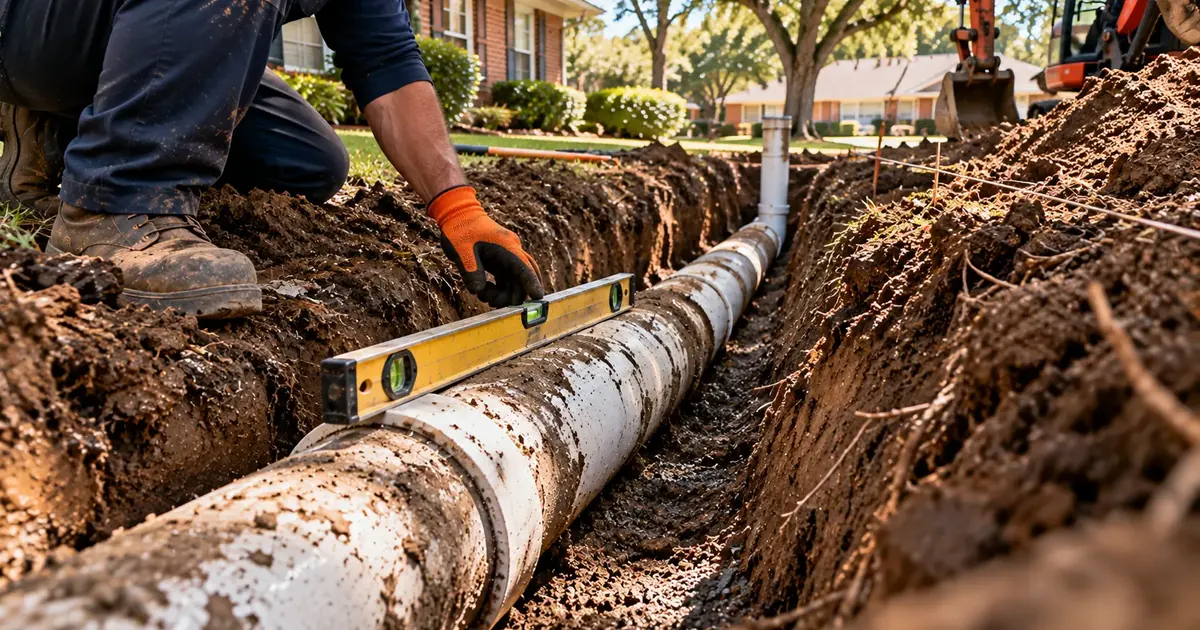
We remove the soft soil, lay compacted gravel bedding and set new PVC pipe at the correct slope, checked with a level.
Verify the flow
A final camera run shows water draining through with nothing pooling before we backfill.
How Much Slope a Sewer Line Needs
For a typical 4-inch house sewer, plumbing codes commonly call for a fall of about a quarter inch per foot. Over a 60-foot line from the house to the street, that is roughly 15 inches of drop. Too flat and solids settle out. Too steep and the water runs ahead of the solids and leaves them behind. When we rebuild a bellied section, we set the new pipe to match the slope of the good pipe on either side, then check it with a level and the camera so the transition is smooth.
Pine Bluff is mostly flat, and some older lines were laid with very little fall to begin with. On those homes, getting the grade right on the repaired section matters even more, because there is not much slope to spare.
Can Lining Fix a Belly?
Not really. A liner takes the shape of the pipe it goes into, so the sag stays. Lining can seal cracks inside a belly but the water will still pool. Re-grading is the fix that removes the low spot. We explain this before recommending any trenchless option.
You get the footage, our honest read on whether the belly needs fixing now, and a price before any digging, which is how we handle all sewer line repair in Pine Bluff.
It may be a belly. Call and my crew will measure it on camera and tell you honestly whether it needs fixing now. 24/7.
Sewer Belly FAQ
How serious is a belly in a sewer line?
It ranges from harmless to a constant clog. The depth of standing water and whether solids collect there tell you which.
Does insurance cover a bellied sewer line?
Standard policies often treat settling as wear and tear. Some sewer line endorsements do cover it. Check your policy or ask for our claim help.
Will a belly get worse over time?
Often, yes, especially if a leaking joint nearby keeps washing out soil. A camera check every year or two shows whether it is growing.