
Sewer pipe lining, also called cured-in-place pipe or CIPP, puts a resin-soaked felt or fiberglass tube inside your existing sewer line and hardens it in place, creating a new one-piece pipe within the old one. It seals cracks and joints so roots and leaks cannot get through. A short sectional or point liner does the same for just one bad spot.
Lining is the most common trenchless repair, and on the right pipe it works very well. The old clay or cast iron stays in the ground as a shell, and a smooth, one-piece pipe forms inside it. Roots have no joints left to find, and small cracks are sealed over. All of this happens through a cleanout and, when needed, one small access hole.
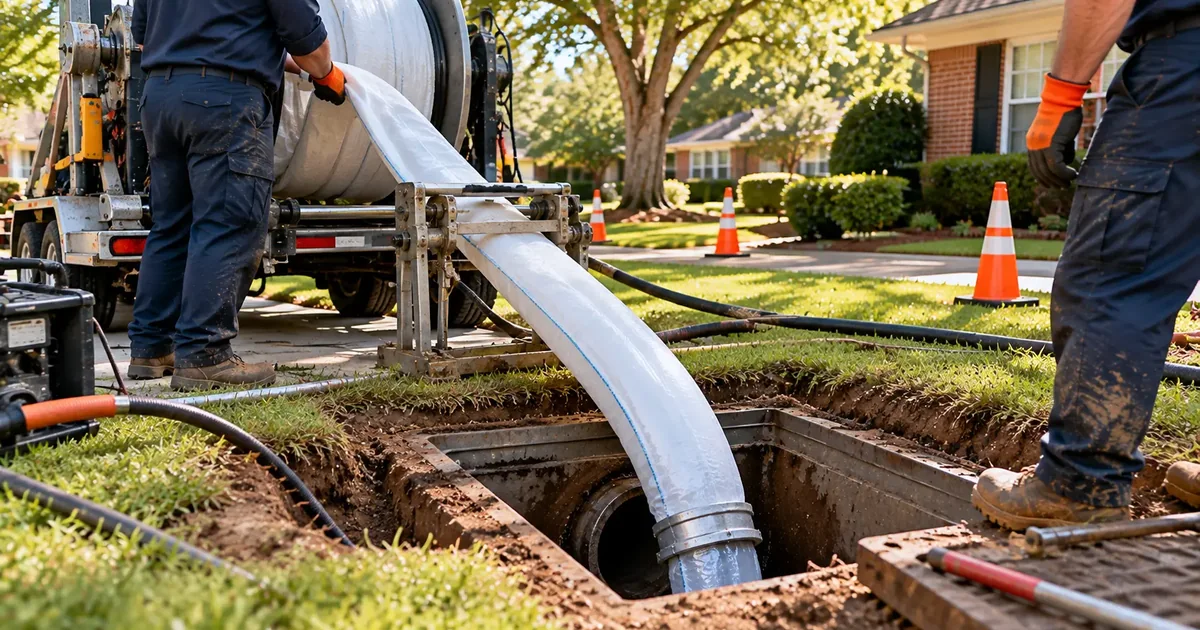
Full-Length Lining vs. Point Liners
| Full-length liner | Point (sectional) liner | |
|---|---|---|
| Covers | The whole run from the house to the city main, or a long section | A few feet at one damaged joint or crack |
| Best for | Roots or cracks at many joints along the line | One or two bad spots in otherwise sound pipe |
| Digging | Usually a cleanout and possibly one small pit | Often none beyond the cleanout |
Is Your Pipe a Candidate?
A liner takes the shape of the pipe it goes into, so the pipe has to be in the right condition. Good candidates:
- Clay or cast iron that is cracked or has leaking, root-prone joints, but is still round.
- A line under a driveway, patio or mature tree you do not want to disturb.
- Pipe with pinholes or minor corrosion that has not broken through large areas.
Not good candidates:
- A belly: the liner follows the sag, so water still pools.
- A collapsed section: the liner cannot pass or has nothing to form against.
- Large offsets: the liner can wrinkle or block at the step.
- Badly flattened Orangeburg pipe, which usually needs bursting or replacement instead.
The camera inspection answers this before any quote, and we will say plainly if your pipe does not qualify.
How Lining Works
Inspect and measure
The camera confirms the pipe condition and we measure length and diameter.
Clean the pipe
Hydro jetting removes roots, grease and scale, since the liner needs a clean surface.
Install the liner
The resin-soaked liner is pulled or inverted into place and held against the pipe wall while it cures hard.
Reopen and inspect
Any branch connections are reopened and a final camera run shows the finished pipe.
Why Lining Suits Older Pine Bluff Lines
A lot of homes here have clay sewer lines laid in short sections, which means dozens of joints between the house and the street. Under mature trees in neighborhoods like Lake Saracen, Watson Chapel or around Fifth Avenue, roots find those joints again and again. Cutting roots every year or two adds up. A full-length liner removes every joint in one job, which is why it is often the better long-term value for a line with roots at many joints but no sags or collapses.
What Lining Changes Inside the Pipe
A liner is only a few millimeters thick, so the inside diameter shrinks a little. Because the new surface is smooth and jointless, flow is usually as good or better than the old rough, root-filled pipe. For a standard 4-inch house line, that small reduction is rarely an issue.
What to Expect on Lining Day
Most homes are without sewer use for part of one day. The crew arrives, confirms the cleanout access and jets the line clean. The liner is prepared on site, installed and then cured, which is the step that takes the longest. Once it is hard, any side connections are reopened with a cutting robot, and we run the camera through the new pipe so you can see the finished result before we pack up. There is no trench to backfill and no sod to replace.
Lining or Replacement?
If the camera shows the pipe is round and the damage is cracks and joints, lining often beats digging, especially under hardscape. If the line has sags, collapses or is undersized, sewer line replacement or pipe bursting is the better fix. Read pipe lining vs. pipe bursting for a side-by-side. Either way, the footage decides, just like every sewer line repair in Pine Bluff we do.
Call and my crew will camera the line and tell you honestly whether lining will work, with a price before we start. 24/7.
Sewer Pipe Lining FAQ
How long does a pipe liner last?
Cured-in-place liners are designed for decades of service when the pipe is properly cleaned and prepared before installation.
Can roots grow through a liner?
A properly installed liner has no joints, so roots have no gap to enter through the lined section.
Can cast iron pipe be lined?
Yes, if it is still structurally round. Heavily scaled cast iron needs thorough cleaning first. See cast iron sewer pipe replacement if it is too far gone.