
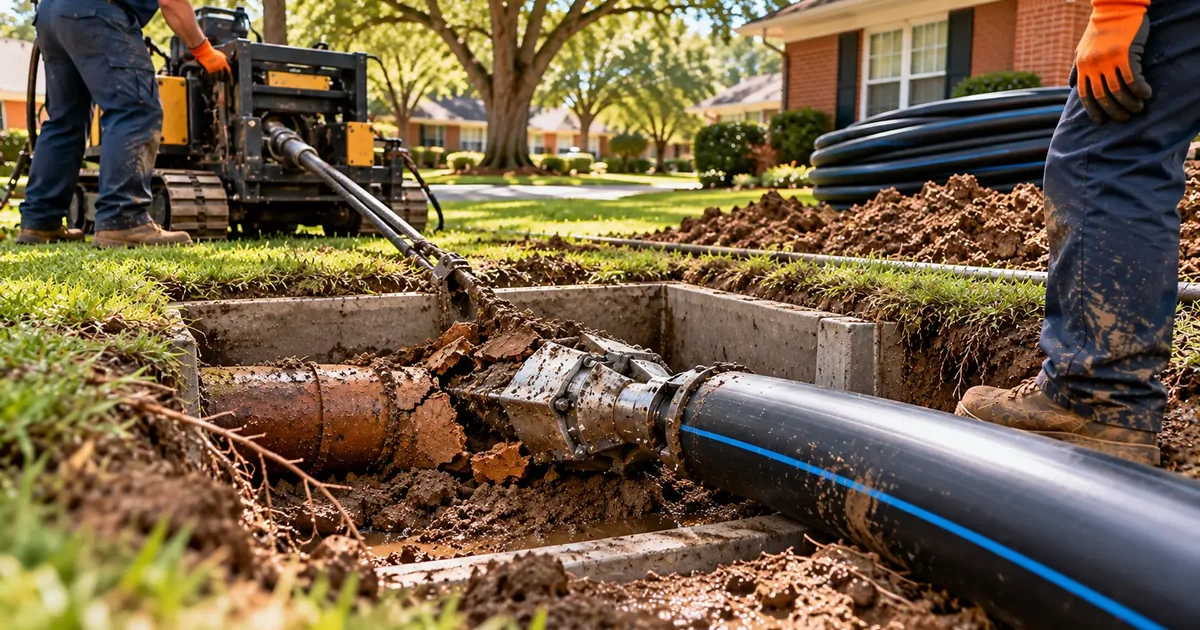
Pipe bursting replaces an old sewer line without digging a trench along it. A cone-shaped bursting head is pulled through the old pipe, breaking it apart and pushing the pieces into the surrounding soil, while a new one-piece HDPE pipe is pulled in right behind it. Only two small pits are dug, one at each end of the run.
Pipe bursting is the trenchless answer for a line that is too far gone to line. Cracked clay, crumbling cast iron and undersized old pipe can all be replaced in the same path they already follow, and the new pipe can be the same size or even larger than the old one. For a sewer line that runs under a driveway, sidewalk or big tree, it can save a lot of concrete and landscaping.
How Pipe Bursting Works
Camera and plan
A camera inspection maps the line, and the locator marks both ends and any connections along the way.
Dig two pits
After 811 marks buried utilities, we dig an entry pit near the house and an exit pit near the city connection.
Burst and pull
A cable pulls the bursting head through the old pipe, fracturing it outward while the new pipe follows.
Connect and verify
The new pipe is connected at both ends and a final camera run confirms a smooth, continuous line.
When Pipe Bursting Is the Right Fix
- The line is cracked, broken or corroded along much of its length.
- The pipe is too damaged or deformed for a liner, such as badly flattened Orangeburg pipe.
- You want the new pipe to be the same size or larger than the old one.
- The line runs under a driveway, patio or landscaping you want to keep.
When It Is Not
- Bellies. The new pipe tends to follow the old path, so a sag can remain. Re-grading by excavation may be needed first.
- Nearby utilities. If gas or water lines run very close to the sewer, bursting may put them at risk, and a trench is safer.
- A single bad spot. A spot repair is cheaper than replacing a whole run.
- Many branch connections. Each one needs its own small dig, which can reduce the advantage.
Why It Fits Many Pine Bluff Homes
A large share of local homes were built between the 1940s and the 1970s, when clay, cast iron and Orangeburg fiber pipe were all in common use. By now many of those lines are cracked at every joint, rusted through or flattening, which rules out lining. In older neighborhoods the sewer often runs under a driveway added decades after the house was built, or right through the root zone of a large oak. Pipe bursting replaces those lines along the same path, so the driveway stays in place and the tree’s main roots are left mostly alone.
What Bursting Day Looks Like
The two pits are usually dug the morning of the job. The bursting machine sits in one pit, the new pipe is laid out on the lawn ready to pull, and the actual burst and pull on a typical house line often takes less time than the digging. After the connections are made at each end, the camera goes through the new pipe, and the pits are backfilled and compacted. Sewer service is off only for the hours the old pipe is out of use.
What the New Pipe Is Made Of
Bursting typically installs high-density polyethylene (HDPE). Its sections are heat-fused into one continuous pipe with no joints, so there is nowhere for roots to get in. It is flexible enough to handle some ground movement, which matters in the clay soils common around Pine Bluff that swell and shrink with the seasons.
Pipe Bursting vs. Lining vs. Trench
| Pipe bursting | Lining | Open trench | |
|---|---|---|---|
| Old pipe condition | Can be badly damaged | Must be round and sound enough | Any |
| New pipe size | Same or larger | Slightly smaller | Any |
| Digging | Two pits | Minimal | Full-length trench |
| Fixes a belly | Not reliably | No | Yes |
Compare them in detail in pipe lining vs. pipe bursting.
Cost
Pipe bursting pricing depends on the length of the run, depth, soil and the number of connections. It often costs more per foot than trenching but saves the cost of replacing concrete and landscaping. You get both options priced side by side after the camera, which is how we handle all sewer line repair in Pine Bluff.
Call and we will camera it and price pipe bursting and trench replacement side by side. Licensed and insured, 24/7.
Pipe Bursting FAQ
What happens to the old pipe?
It breaks into pieces that are pushed into the surrounding soil and stay there. They do not affect the new pipe.
How long does pipe bursting take?
Most residential lines are replaced in one to two days, including digging and closing the pits.
Can you burst Orangeburg pipe?
Often yes. It is one of the common uses for bursting, since flattened Orangeburg usually cannot be lined.