
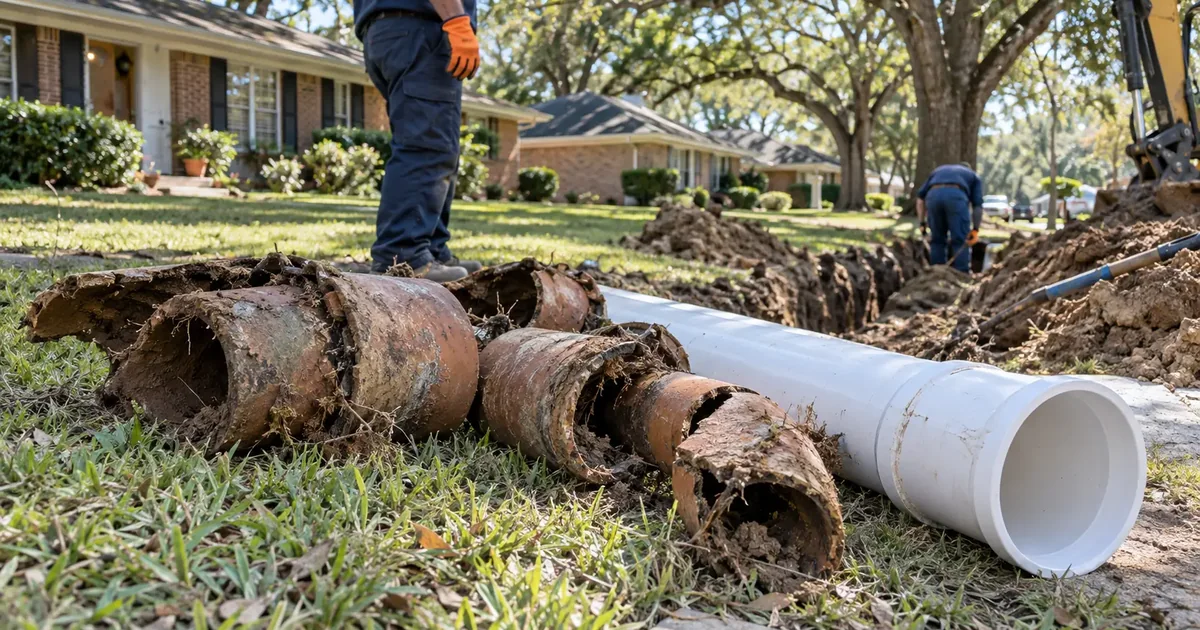
Clay sewer pipe, also called vitrified clay or terracotta, was the standard sewer material for much of the 1900s. The clay itself can last a very long time, but it was laid in short sections with many joints that loosen, crack and let roots in. When the camera shows damage at many joints, the fix is to line the pipe or replace it with PVC, which has far fewer joints and resists roots.
If your home was built before the 1960s, and especially if it sits in an older part of town like the Fifth Avenue Historic District or near downtown, there is a good chance clay pipe carries your waste to the street. Clay does not rust and resists chemicals well. Its weakness is the joints. Old clay came in lengths of about 2 to 3 feet, so a 60-foot line can have 20 to 30 joints, each one a possible entry point for roots and a place where the pipe can crack or shift.
How Clay Sewer Lines Fail
- Root intrusion. The mortar or early gaskets at the joints break down and roots grow inside.
- Cracks. Clay is rigid and brittle. Ground movement, roots and heavy loads crack it.
- Offsets. Individual sections shift up, down or sideways as the soil moves.
- Breaks and collapses. A cracked section eventually loses its shape and falls in.
Much of the soil around Pine Bluff is clay that swells when wet and shrinks when dry. That constant movement is hard on short, rigid pipe sections, which is why clay lines here often show offsets and cracks along with roots.
Repair, Line or Replace?
Clay is not automatically bad. We often see clay lines in decent shape with one or two trouble spots. The camera decides:
| What the camera shows | Recommended fix |
|---|---|
| Sound pipe, roots at a couple of joints | Root removal plus spot repair or point liners |
| Roots or cracks at many joints, pipe still round | Pipe lining seals every joint |
| Many offsets, bellies or breaks | Replacement by trench or pipe bursting |
| Clay mixed with old repairs in different materials | Usually replacement of the whole run |
How We Replace a Clay Line
Camera every joint
A camera inspection records the condition of each joint and section.
Price the options
You see prices for repair, lining and replacement when more than one makes sense.
Install new pipe
Clay comes out and glued PVC goes in on firm bedding at the right slope, or new HDPE is pulled through by bursting.
Verify
A final camera run and inspection confirm the new line before backfill.
Why PVC Replaces Clay
PVC comes in long lengths, so a replacement line has a fraction of the joints clay had. Its joints are glued, which leaves roots nothing to push into. It is lighter and slightly flexible, so it handles ground movement better than rigid clay, and its smooth inside wall keeps waste moving. Where the new PVC meets any clay that stays in place, we use shielded couplings built for joining the two materials.
Clay Lines and Old Repairs
Many clay lines in older Pine Bluff neighborhoods have been patched more than once over the decades. On camera we regularly find a clay run with a short stretch of cast iron in the middle, a section of PVC from a past repair, and rubber boots holding them together without steel shields. Each change of material is another joint that can sag or let roots in. When a line has three or four different materials and several patches, fixing one more spot usually just adds another transition. That is often the point where replacing the whole run with one continuous PVC line saves money over the next ten years, and we will lay out both options side by side so you can compare.
What It Costs
A clay line replacement is priced on length, depth, the method and what sits on top of the line. You get the footage and the price before any work. If only part of the clay line is failing, you only pay to fix that part. Financing is available for larger jobs.
Our guide how long clay sewer pipes last explains what to expect from an older line, and our approach to all sewer line repair in Pine Bluff starts with the camera.
Call and my crew will camera every joint and tell you honestly whether to repair, line or replace. Price before we dig, 24/7.
Clay Sewer Pipe FAQ
Do all clay sewer pipes need replacing?
No. Clay in good condition can keep working. Replacement makes sense when the camera shows damage at many joints or sections.
Can clay sewer pipe be repaired?
Yes. Individual bad sections can be cut out and replaced with PVC, or sealed with point liners.
Is clay pipe still used today?
Modern vitrified clay with better joints is still used in some municipal systems, but most house sewer lines today are PVC.