
Cast iron sewer pipe was common in homes built from the early 1900s through the 1970s. It is strong, but it corrodes from the inside, forming rough scale that catches waste and eventually rusting through along the bottom of the pipe, a failure called channel rot. Badly corroded or cracked cast iron is replaced with PVC, or lined if the pipe is still structurally sound.
Cast iron has a reputation for lasting forever, and in dry conditions it can last a very long time. Underground and under slabs, it lives in constant moisture, and the sewer gases inside it attack the pipe wall. Over decades the inside becomes rough with rust scale, which catches paper and slows drains. Along the bottom, where water always sits, the metal thins until it splits open.
Where Cast Iron Shows Up in Pine Bluff Homes
We most often find cast iron under the slabs and crawlspaces of homes built in the 1950s and 1960s, and as the pipe leaving the house in older homes that switch to clay farther out in the yard. Ranch houses from that era in neighborhoods across Pine Bluff frequently have cast iron running under the kitchen and bathrooms, which is why cast iron problems often show up as under-slab leaks rather than yard leaks.
Signs Your Cast Iron Is Failing
- Slow drains that clog again soon after clearing, caused by rough scale inside the pipe.
- Rust-colored water or flakes when a drain is cleared.
- Sewer smell inside the house with no obvious source.
- Cracks in slab floors or damp spots near bathrooms.
- A camera showing heavy scale, holes or a missing pipe bottom.
Repair, Line or Replace?
| Camera finding | Fix |
|---|---|
| Heavy scale, pipe wall still solid | Descaling with specialized cutters, then possibly lining |
| One cracked or rotted section | Spot repair with PVC and shielded couplings |
| Channel rot along much of the run | Replacement by trench, tunnel or reroute |
| Failing under a slab | Under-slab repair options |
Lining cast iron only works if the pipe still has a bottom. Once channel rot has opened the floor of the pipe, the liner has nothing solid to form against in that section.
How We Replace Cast Iron
Camera and test
A camera inspection shows the condition, and a pressure test confirms leaks under slabs.
Plan the access
Yard runs get a trench or pit; runs under the house get tunneling, a floor cut or a reroute.
Swap to PVC
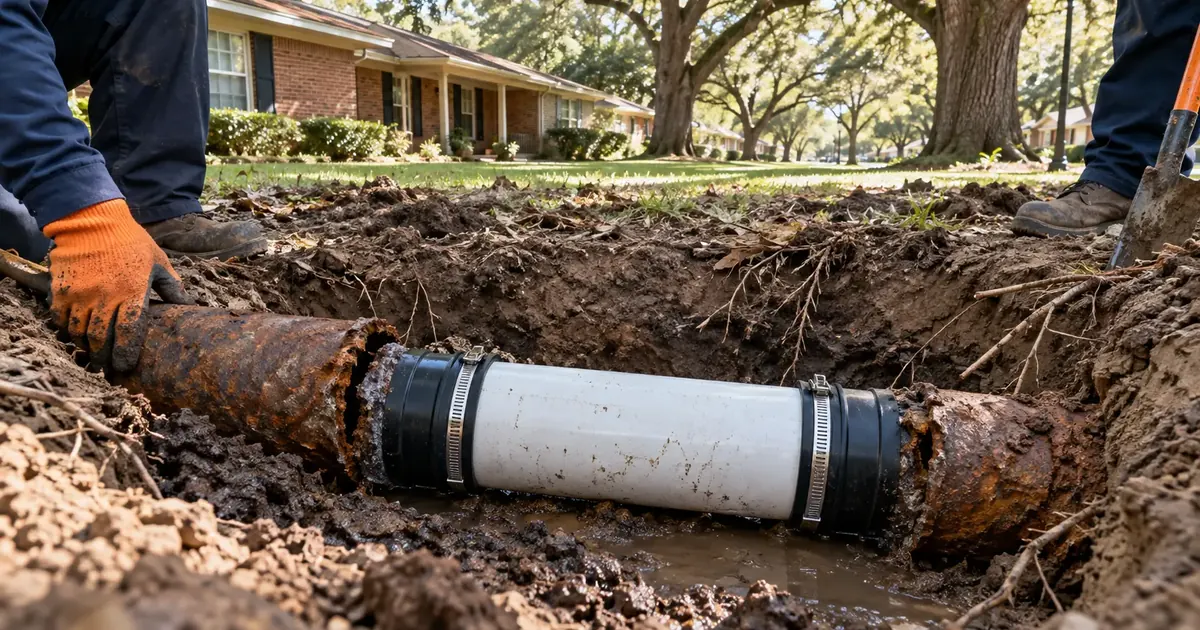
Failed cast iron is cut out and replaced with PVC. Shielded couplings join new PVC to any cast iron that stays, so the joint cannot slip.
Support and verify
New pipe is supported and sloped correctly, then camera-checked and inspected.
Why Shielded Couplings Matter
Cast iron and PVC have different outside diameters. A plain rubber coupling can let the two pipes sag or offset over time. A shielded coupling wraps the rubber sleeve in a stainless steel band that holds both pipes in line, which is the standard way to make that transition last.
Descaling: When Cast Iron Can Be Saved
Not every rough, slow cast iron line needs to come out. If the camera shows heavy scale but a solid pipe wall with no holes, descaling can restore flow. A spinning chain or cutting head knocks the rust and buildup off the inside wall, and a follow-up camera run shows the pipe underneath. If that pipe is sound, you may get years more use out of it, or it can be lined afterward to seal it for the long term. If descaling uncovers thin spots or holes, we stop and show you before going further. That way you only pay for replacement when the pipe truly needs it.
What It Costs
Yard replacements are priced like other line replacements, on length, depth and method. Under-slab work costs more because of access. You get the camera footage, test results and a price before anything is cut, with financing available for larger jobs.
Read how long cast iron sewer pipes last to understand your pipe’s age, and see how we approach all sewer line repair in Pine Bluff.
Call and my crew will camera your cast iron and show you exactly how far the corrosion has gone. Price before we cut or dig.
Cast Iron Sewer Pipe FAQ
How long does cast iron sewer pipe last?
It varies widely with soil, moisture and use. Many older lines show serious corrosion after several decades, while some last much longer.
Should I replace cast iron before it fails?
Not automatically. If the camera shows solid pipe, keep it. If it shows thinning or channel rot, planned replacement avoids a slab leak emergency.
Can hydro jetting damage cast iron?
Jetting at the right pressure is safe for sound cast iron. Pipe that is badly thinned needs a gentler approach, which the camera tells us before we start.